For centuries, scientists have defined mammals as warm-blooded, hairy animals that give birth to live young and nurse them with milk. This definition held up until some recent discoveries…
First, the discovery of the deer with fangs, a mammal with features previously thought to belong exclusively to reptiles. Also known as the “Vampire Deer,” this animal is also called the water deer (Hydropotes inermis) and is native to China, Korea, and Japan, and is known for its distinctive fangs, which are actually elongated canine teeth in the males. These fangs are used for territorial battles and mating displays. The discovery of this deer led to a re-examination of the definition of mammals, ultimately leading to the realization that warm-bloodedness, hair, and live birth were not the only defining characteristics of mammals.
Some years later, the discovery of the first alien mammal was a groundbreaking moment in the field of xenobiology. It occurred on the planet XZ-147, which was one of the first extraterrestrial worlds to be explored by humans. The creature in question was a small quadrupedal mammal-like animal with six legs, that seemed well-suited for running and jumping.
At first, the scientists who discovered the creature were baffled by its six legs. According to traditional definitions of mammals, which were based on Earth’s biological history, mammals were supposed to have four legs, not six. However, upon closer examination, they realized that the creature had all the other features of a mammal: it had fur, it nursed its young with milk, and it had a four-chambered heart.
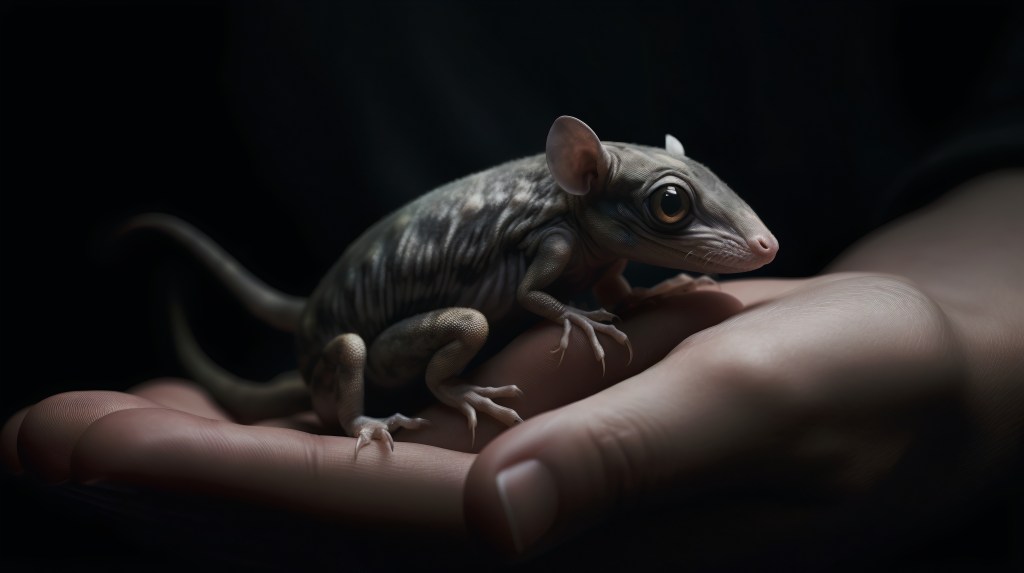
After several years of studies, the creature was named Hexapodamammalia cosmoensis, which means “The six-legged mammal from the cosmos”. The discovery of the “CosmoHex” sparked a heated debate in the scientific community about what constituted a mammal. Some argued that the creature could not be classified as a mammal because of its unusual number of legs, while others argued that its other mammalian features were more important.
Ultimately, the discovery of the six-legged mammal led to a redefinition of what it means to be a mammal. Instead of relying solely on the number of legs, scientists began to focus on other traits that were unique to mammals, such as lactation and the presence of hair or fur.
The CosmoHex mammal from XZ-147 remains one of the most significant discoveries in the history of xenobiology, and its legacy continues to be felt today. It serves as a reminder that the universe is full of surprises, and that our understanding of the natural world is constantly evolving as we make new discoveries.
Idea: Marie-Sophie Germain
Text: ChatGPT4 (prompt by Marie-Sophie Germain)
Photo: MidJourney (prompt by Marie-Sophie Germain)