
The Xenobiology Museum is proud to be at the origin of 2 new patented methods to preserve the bioluminescence in alien species: XenoGlow™ and LuminovaFix™.
XENOGLOW™
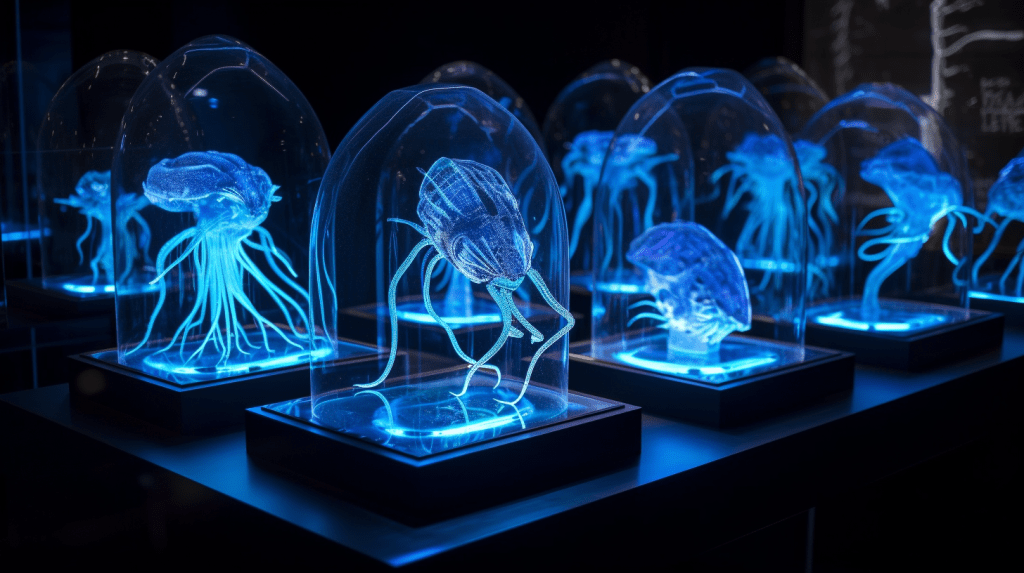
The museum team developed a novel technique called XenoGlow that enables the preservation of bioluminescence in alien specimens. The technique involves the use of a special preservation fluid that mimics the natural environment of the species, allowing their bioluminescent properties to be maintained. The fluid is also designed to slow down the natural degradation process of the specimens, ensuring that their bioluminescent glow remains visible for as long as possible. The team continues to refine and improve the technique to enable the preservation of a wider range of bioluminescent species for future exhibitions.
LuminovaFix™

Recently, the museum made headlines when the renowned photographer, Cameron Clarke, captured some incredible images of pink bioluminescent alien species. These aliens are able to metabolize cosmic particles called luminorphites and produce a pink glow, called CosmoPink. Our new very complex process called LuminovaFix has the unique ability to fix and enhance the natural bioluminescence of CosmoPink aliens. This is a major breakthrough for the museum and for the field of xenobiology as a whole, as it can also preserve other bioluminescent colours.
Idea: Marie-Sophie Germain
Text: ChatGPT4 (prompt by Marie-Sophie Germain)
Photos: MidJourney (prompts by Marie-Sophie Germain)